Most of us know we should eat more vegetables. Very few of us actually do. In 2019, only 10% of U.S. adults met the recommended daily amount of vegetables, and only 12.3% met the recommendation for fruit, according to the Centers for Disease Control and Prevention. The guideline for most adults is about 2 to 3 cups of vegetables a day.
If that number surprises you, you are in good company. And if you are wondering whether a "greens" or leaf supplement can make up the difference, this article gives you an honest answer: it can be a useful extra, but it isn't a shortcut around real food.
Why the vegetable gap is so common
It usually isn't a lack of willpower. Vegetables take time to wash and prepare, fresh produce spoils quickly, and busy weeknights favor whatever is fastest. Many people also simply didn't grow up eating a wide range of vegetables, so they stick to the two or three they know.
The good news: small, repeatable changes add up faster than big diet overhauls.
Seven easy ways to eat more vegetables
- Keep frozen vegetables on hand. They are pre-washed, pre-cut and don't spoil in a few days.
- Add a handful to what you already cook. Spinach in eggs, peppers in pasta sauce, beans in soup.
- Double the vegetable side at dinner and make it the first thing on the plate.
- Use one sheet pan. Roast a tray of mixed vegetables on Sunday and use them all week.
- Put washed produce at eye level in the fridge so it's the first thing you see.
- Blend greens into a morning smoothie with fruit you already like.
- Try one new vegetable a week. Variety makes the habit easier to keep.
What "2 to 3 cups" looks like in a day
The CDC report measures adults against federal guidelines of about 1.5 to 2 cups of fruit and 2 to 3 cups of vegetables a day. That can sound like a lot, but spread across a day it adds up faster than you might think:
- Breakfast: a handful of spinach folded into eggs or blended into a smoothie.
- Lunch: a side salad or a bowl of vegetable soup.
- Snack: baby carrots, sliced peppers or cucumber with hummus.
- Dinner: half the plate filled with cooked vegetables, fresh or frozen.
You don't have to get it perfect every day. Adding one extra serving a day is a realistic place to start, and it's easier to keep going once it becomes routine.
Where leaf supplements come in
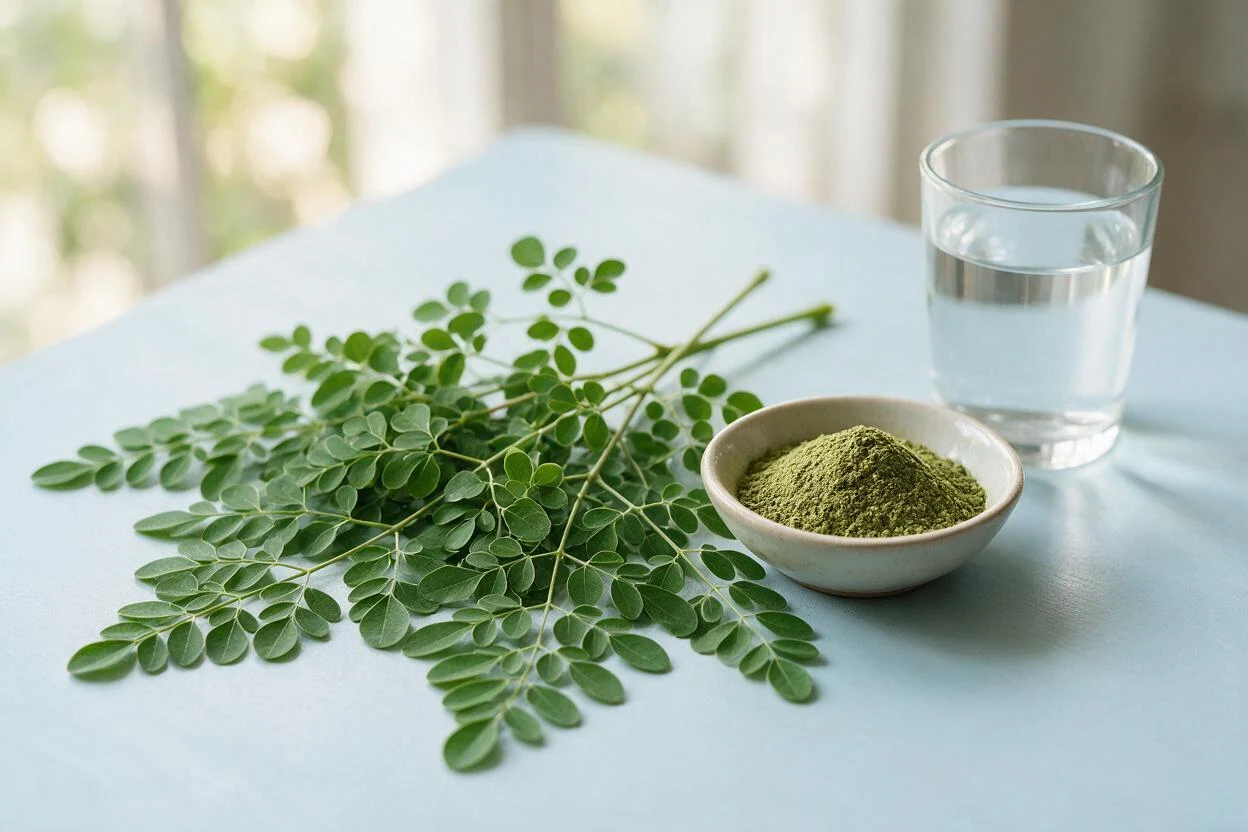
Some people add a plant-based supplement on top of these habits. One of the most talked-about is moringa (Moringa oleifera), a fast-growing tree whose leaves are eaten as a vegetable in parts of Asia and Africa.
When researchers analyzed dried moringa leaf powder from Zambia, they found it contained large amounts of protein, minerals and vitamins, including iron, calcium and carotenoids. A 2015 review in Phytotherapy Research reported that no adverse effects were seen in the human studies available at the time, while noting that "standardization of products is an issue."
It's important to keep this in perspective. A major scientific review of moringa leaves concluded that there are still too few human studies to recommend moringa as a treatment for any condition. And a typical capsule serving is small, under one gram of leaf. So think of a moringa supplement as a convenient daily addition to a balanced diet, not a replacement for vegetables.
One option: Moringa by Fernwyn
If you would like to try a moringa supplement, Moringa by Fernwyn is a simple, single-ingredient option. Each serving is two vegetable capsules containing moringa leaf, with no added blends. According to the company, the capsules are non-GMO, made in a GMP facility, sold as a one-time purchase rather than a subscription, and backed by a 60-day money-back guarantee.
Moringa by Fernwyn: what's in it
| Moringa oleifera leaf: 800 mg per serving (2 vegetable capsules) |
|---|
| Other ingredients: cellulose (vegetable capsule) |
| Per bottle: 60 capsules, a 30-day supply |
| Suggested use (per the company): 2 capsules a day with water, 20 to 30 minutes before a meal |
| Made by: Ancient Energies LLC, 3422 Old Capitol Trl, PMB 1518, Wilmington, DE 19808. Source: product page, checked Nov 12, 2026 |
One serving won't give you the nutrients of a plate of vegetables. Results from any supplement vary from person to person. And if you already eat plenty of vegetables, you may not need it at all. Where it makes the most sense is alongside the food changes above.
Common questions
Can a moringa supplement replace vegetables?
No. Whole vegetables provide fiber, water and volume along with their nutrients, and a serving of capsules contains less than a gram of dried leaf. Use it as an addition, not a substitute.
Is moringa safe?
Moringa leaves are eaten as food in many countries, and a 2015 review found no adverse effects reported in the human studies available at the time. Supplements are not the same as food, though, and quality varies between products. Check with your doctor first if you are pregnant, breastfeeding or take any medication.
How soon will I notice a difference?
There is no research-backed timeline for a moringa supplement, and many people may not notice anything specific. The food habits above are where you are most likely to see a real change in how you eat.
Start with food habits
Nine out of ten adults fall short on vegetables, so if you do too, you are far from alone. The biggest gains come from simple food habits: frozen vegetables, one extra serving at dinner, a weekly sheet pan. A moringa leaf supplement can be a convenient extra on top of that, as long as you treat it as a supplement and not a substitute.
These statements have not been evaluated by the Food and Drug Administration. This product is not intended to diagnose, treat, cure, or prevent any disease.
Talk to your doctor before starting any supplement, especially if you are pregnant, breastfeeding, or take prescription medication. This article is general information, not medical advice.
Sources & further reading
- Lee SH et al. Adults Meeting Fruit and Vegetable Intake Recommendations — United States, 2019. MMWR, Jan 7, 2022
- Nutritional characterisation of Zambian Moringa oleifera… Int J Food Sci Nutr, 2019
- Stohs SJ, Hartman MJ. Review of the Safety and Efficacy of Moringa oleifera. Phytother Res, 2015
- Leone A et al. Cultivation, Genetic, Ethnopharmacology, Phytochemistry and Pharmacology of Moringa oleifera Leaves: An Overview. Int J Mol Sci, 2015
- Product details: Moringa by Fernwyn "Daily Routine" page (company information)
Published by Simple Strong Living. Questions or a correction? Get in touch.